Fiat-to-Crypto Payment Gateway: How Card Payments Become USDC
By Qist Engineering · Published 2 Mayıs 2026

A fiat-to-crypto payment gatewayis a checkout layer that lets buyers pay with a Visa card, Apple Pay, or Google Pay — and delivers USDC (or another stablecoin) to the merchant's wallet instead of wiring dollars through a traditional acquiring bank. The buyer never touches a crypto wallet. The merchant never touches a traditional merchant account. The card network never sees a restricted-category merchant descriptor. For restricted-vertical shops — peptides, nutra, SARMs, kratom, CBD, adult, supplements — this is the payment architecture that makes "accepting cards" possible when Stripe, PayPal, and every acquiring bank in the country has already said no.
What is a fiat-to-crypto payment gateway?
A conventional payment gateway routes a card swipe through an acquiring bank that settles in fiat — US dollars, euros, pounds. A fiat-to-crypto payment gateway routes the same card swipe through a crypto on-ramp provider(Moonpay, Transak, Banxa, Ramp Network) that converts the fiat into a stablecoin and pushes it on-chain to the merchant's wallet in one atomic transaction.
From the buyer's perspective, the experience is identical: enter card number, tap Apple Pay, or use Google Pay. From the card network's perspective, the transaction is classified under MCC 6051 ("quasi-cash / crypto on-ramp") — not under the restricted MCC 5122 that gets peptide shops auto-banned. From the merchant's perspective, USDC lands directly in a Polygon wallet they own, typically within 30–90 seconds of payment clearing, with no custodial intermediary ever holding the funds.
How the fiat→USDC conversion actually works
The flow has four actors: the buyer, the on-ramp provider, the on-chain splitter contract, and the merchant's wallet. Here is the full sequence for a typical checkout:
- Buyer submits card details on the hosted checkout page (e.g.
pay.qistdigital.com/session/cs_…). The payment form is served by the on-ramp provider — not by the merchant — so the merchant never touches card data and PCI scope is zero. - On-ramp acquires the fiat transaction. The acquiring bank sees a crypto-purchase descriptor (MCC 6051) from a regulated on-ramp (Moonpay has EMI licences in 50+ countries, Transak has MSB registration in the US). The issuing bank approves it like any currency exchange transaction.
- USDC is minted or transferred on Polygon (or BNB Chain, Base, depending on the on-ramp). The on-ramp pushes the net USDC amount (gross amount minus on-ramp fee of ~4.5%) to an on-chain splitter contract.
- Splitter forwards funds to the merchant wallet. In Qist's architecture, a PayGate splitter on Polygon routes ~98% of the USDC directly to the merchant's Polygon address and 2% to a treasury address. Total end-to-end: under 90 seconds from card swipe to on-chain confirmation.
- IPN + webhook. The payment processor receives an Instant Payment Notification from the on-chain layer, verifies the on-chain confirmation, and fires a signed HMAC webhook to the merchant's backend — flipping the order to "paid" automatically.
Why restricted-vertical merchants specifically need a fiat-to-crypto gateway
Traditional card processing requires an acquiring bank to underwrite the merchant's business category. Acquiring banks have hard-blocked merchant category codes — MCC 5122 (drugs and druggists' sundries), MCC 5912 (pharmacies), MCC 8099 (health and allied services) — that trigger automatic rejection or account closure. Stripe, PayPal, and Square all use automated descriptor scanning to enforce this at signup and during processing.
A fiat-to-crypto payment gatewaysidesteps this entirely. The on-ramp provider (Moonpay) is the actual merchant of record for the card transaction. Moonpay's descriptor reads as a crypto exchange purchase (MCC 6051) — a category that Visa and Mastercard permit globally under their money-service-business rules. The underlying goods or services purchased with the resulting USDC are invisible to the card network.
Fiat-to-crypto gateway vs the alternatives
There are four main architectures for accepting payments in restricted verticals. Here's how they compare across the metrics that matter for a solo founder or small team:
| Architecture | Buyer pays with | Merchant receives | Requires LLC? | Onboarding | Fee | Chargeback risk |
|---|---|---|---|---|---|---|
| Traditional Stripe / PayPal | Card / PayPal | USD (bank) | Yes | 2–7 days | 2.9% + 30¢ | Merchant bears it — account freeze risk |
| High-risk PSP (CCBill / AllayPay) | Card | USD (bank) | Yes | 2–4 weeks | 8–10% | Rolling reserve $5k–$50k |
| Crypto-only (NowPayments) | Crypto wallet only | BTC / ETH / USDC | No | < 1 hour | 0.5–1% | No chargebacks — but 85–90% of buyers decline |
| Fiat-to-crypto gateway (Qist) | Card / Apple Pay / Google Pay / USDC | USDC (wallet) | No | Same day | 3% flat | Transferred to on-ramp provider |
The "crypto-only" row deserves a note: NowPayments, CoinGate, and BitPay only convert customers who already own crypto and are willing to send from a wallet. Studies across multiple e-commerce verticals show that 85–92% of buyers abandon crypto-only checkouts. A fiat-to-crypto gatewayis the model that preserves "card accepted here" UX while routing the settlement through the crypto on-ramp layer. It is not the same product as a native-crypto payment processor.
On-ramp providers under the hood: Moonpay, Transak, Banxa
Most fiat-to-crypto gateways aggregate multiple on-ramp providers to maximize card approval rates across geographies. The three dominant on-ramps in 2026 for e-commerce use cases are:
- Moonpay — largest coverage, EMI-licenced in EU/UK, licensed as VASP in multiple US states, integrates Apple Pay and Google Pay natively. Used by Uniswap, MetaMask, and most DeFi front-ends as the default card on-ramp. CPC ~4.5% on card purchases.
- Transak— strong in Asia-Pacific and India; covers local payment methods (UPI, etc.) that Moonpay doesn't. Good fallback for SEA and LATAM traffic.
- Banxa — strong in Australia and Canada; bank transfer (SEPA, Interac) available in addition to card, which can reduce fees to under 1% for EU buyers willing to use bank transfer.
Qist routes by default through Moonpay for card/Apple Pay/Google Pay and offers USDC direct (no on-ramp) for buyers who already hold crypto — at 1.5% instead of the 3% all-in fee for card purchases.
Integration: from zero to live in under 10 minutes
Qist's fiat-to-crypto checkout is a single API call. Pass the order amount, the settlement wallet, and the success/cancel URLs. The API returns a hosted checkout URL — the buyer lands there, picks their payment method, and the USDC arrives in your wallet automatically. The SDK is shaped like Stripe's checkout.sessions.createso existing LLM-generated Stripe scaffolding needs minimal edits:
One-time setup: get an API key
No LLC required. Navigate to /start, paste a Polygon USDC wallet address, and you receive a sk_live_… API key in seconds. The full API reference is available without login.
Frequently asked questions
Does the buyer need a crypto wallet to use a fiat-to-crypto gateway?
No. The buyer only sees a standard card checkout. The crypto conversion happens entirely on the backend between the on-ramp provider and the merchant wallet. Buyers pay with Visa, Mastercard, Apple Pay, Google Pay, or SEPA — exactly as on any other e-commerce site.
What happens if a buyer does a chargeback on a fiat-to-crypto payment?
The chargeback is filed against the on-ramp provider (Moonpay), not against the merchant. Moonpay is the merchant of record for the card transaction. The merchant's wallet has already received USDC and the on-chain transaction is final and irreversible — a chargeback on the card side does not claw back funds from the merchant's wallet. Moonpay absorbs chargeback risk as a cost of their licensing and underwriting model. This is the most important structural difference from a traditional merchant account.
Is a fiat-to-crypto gateway legal in the EU / France / UK?
On-ramp providers operating in Europe (Moonpay, Transak) hold EMI licences under MiCA and the E-Money Directive. The card transaction processed by the on-ramp is a licensed payment service. The merchant receiving USDC in their wallet is receiving a digital asset — currently not subject to payments licensing in most EU jurisdictions for commercial sales. Merchants should verify local tax treatment of stablecoin receipts with their accountant; for most jurisdictions the USDC receipt is treated as foreign-currency revenue at the prevailing EUR/USD rate.
What is the settlement time compared to Stripe?
Stripe settles in 2–7 business days. A fiat-to-crypto gateway using Polygon USDC settles in 30–90 seconds — the time for on-chain confirmation. The merchant's wallet balance reflects payment instantly and is spendable immediately (swappable to EUR via Uniswap, transferable to an exchange for off-ramping, or used directly for USDC-denominated supplier payments).
Developer questions, straight answers.
Does the buyer need a crypto wallet to use a fiat-to-crypto gateway?
What happens to chargebacks on fiat-to-crypto payments?
Is a fiat-to-crypto gateway legal in Europe?
How fast does a fiat-to-crypto gateway settle vs Stripe?
Related guides

Stablecoin Payments: the USDC-on-Polygon Checkout Guide (2026)
USDC on Polygon: sub-2-second finality, cents of gas, dollar-pegged. Buyers tap Apple Pay, merchants get USDC in their own wallet in 60 seconds.
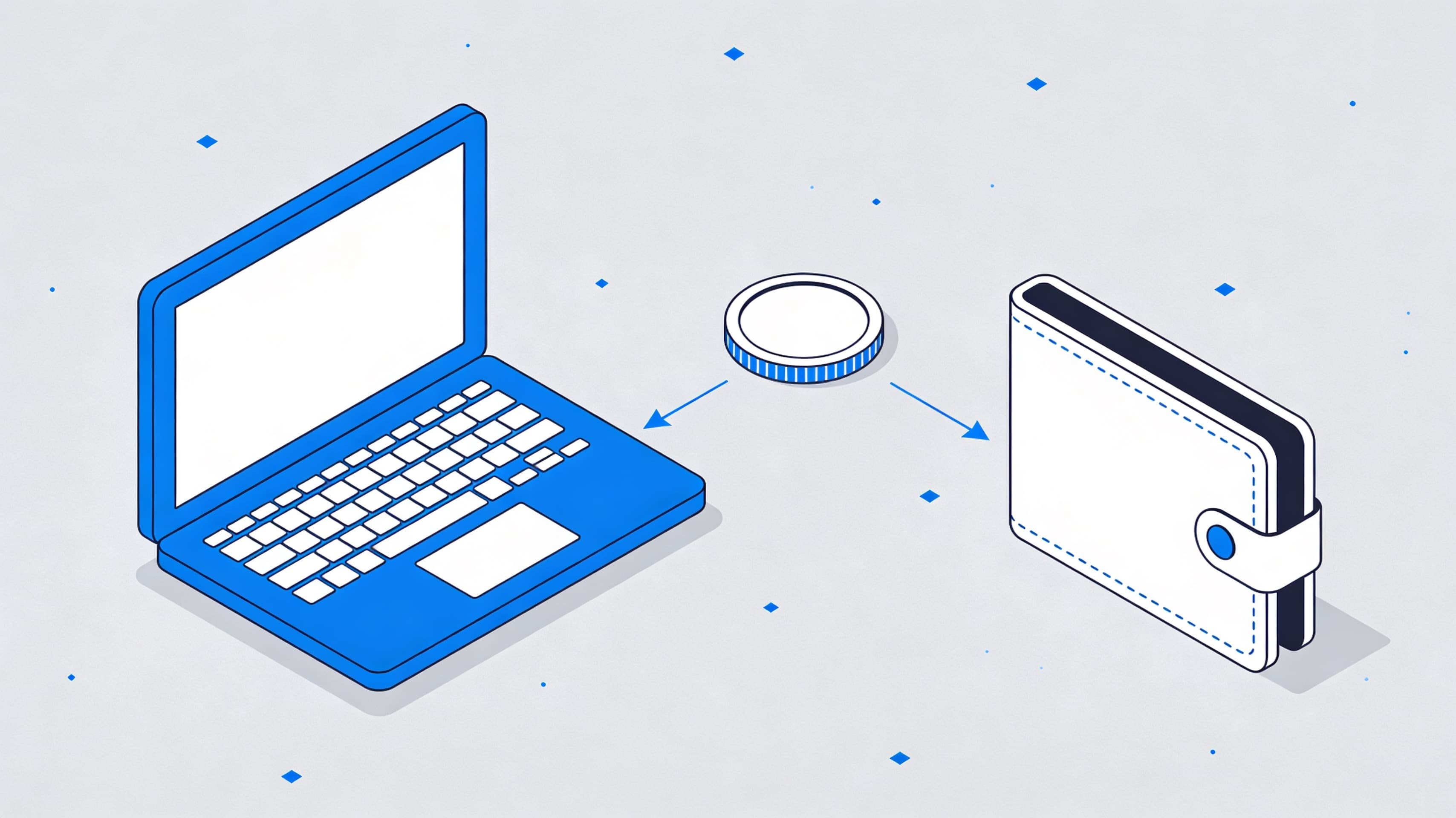
Accept Crypto Payments on Your Website (Non-Custodial, No LLC, 2026)
Non-custodial crypto checkout: card + Apple Pay + USDC in one flow, settlement direct to a wallet you control. No LLC, no off-board risk.
Peptide'ler için High-Risk Payment Gateway: 2026 Rehberi
Geleneksel high-risk PSP (%8–10, LLC, $5k–$50k reserve) vs. Qist'in crypto on-ramp'i (%3 flat, LLC yok, aynı gün). Tam karşılaştırma.
Ready to integrate PeptidePay?
Paste your Polygon wallet, drop in the SDK, done. No LLC required, no rolling reserve, same-day go-live — 3% flat.